Monday, September 17, 2012

Developing Leaders through Service


Kaitlyn Sargent is a Michigan native whose AmeriCorps service has been much different than that of our Michigan’s AmeriCorps members. Read on to learn about her service with AmeriCorps NCCC. 

My name is Kaitlyn Sargent and I was a 2011-12 AmeriCorps NCCC Corps member and am currently a 2012-13 NCCC Team Leader at the Southwest Region based in Denver, CO. NCCC stands for National Civilian Community Corps and members are between the ages of 18 and 24. Members spend 10 months serving in teams to strengthen communities and develop leaders through direct, team-based national and community service. As a Corps Member, I was able to see new places, do amazing things, form meaningful relationships, and give back to others all at the same time. 

Throughout the ten months of service, NCCC members participate in four different project assignments called “spikes.” I loved each and every one of my spikes and wouldn’t trade my experience for anything. When I reflect on my year of service, I feel extremely blessed to have been part of a great team (my second family!) and had incredible project assignments. My first spike was a camping project at Daisy State Park in Daisy, Arkansas. Daisy is a small town with a population of 118. Initially, I was not thrilled to live in a tent for over a month in a city too small for its own zip code in the middle of nowhere, Arkansas… As it turns out, my negative assumptions couldn’t have been more wrong. My team and I came to love Daisy and became a family in the process. Our service tasks at Daisy ranged from park maintenance to making 350 wreaths for a Christmas celebration in a neighboring city. When it came time to head back to Denver, my teammate and I were in tears in the back of the van not ready to say goodbye. 

After spending quality time back home in Michigan for the holidays, I was excited to return to Denver and start my next spike. Round two was spent at Denver Green School serving as a teacher assistant. The transition of working together as a team in isolated Daisy to working individually in classrooms was a bit of a struggle; but by the end of the two months at Denver Green School, we all came to love our classes and our individual experiences. 
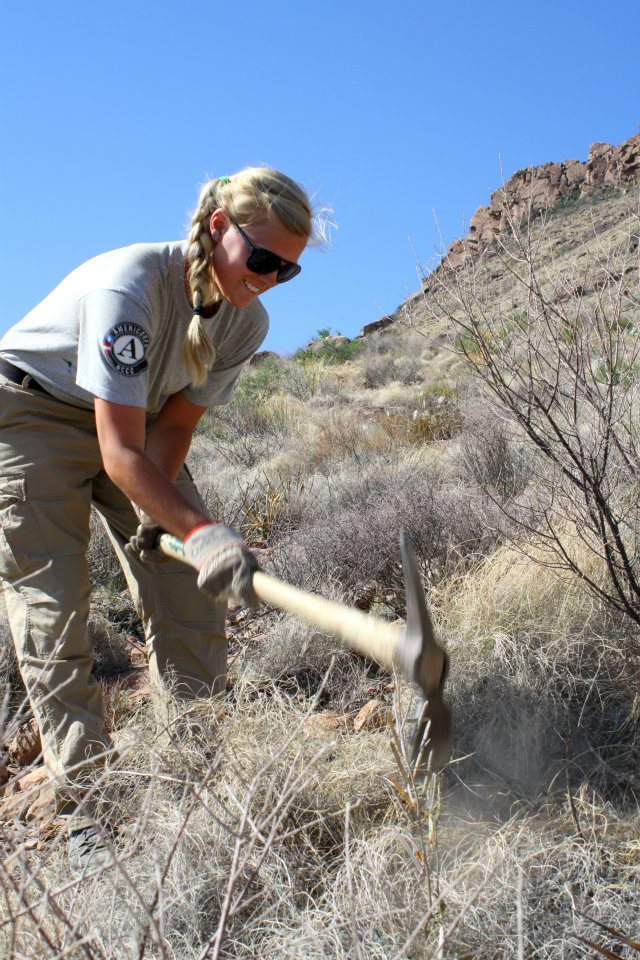
Our third round was “shuffle round” in which teams get mixed up and Corps members have a say in their project assignment. I ended up getting my first-choice project with my roommate, Jenny, so I was very excited! This spike was a split project in Texas where part of the time was spent trail building at Big Bend National Park and the rest of the time was spent helping out at Grand Companions Humane Society in Ft. Davis. Again, the transition was rough as I went from a people project to an extremely isolated project. Big Bend was another camping project where we stayed in tents in the middle of the desert without any indoor access, cell service, or internet (which was quite an adjustment!).

Aside from the harsh living conditions, the work was more physically intense than anything I’ve experienced. We would wake up before the sun came up, hike up to four miles to get to our service site, work on building trails, hike back down, and go to bed. This was the routine for six weeks straight as we built more than half of the 2.7 mile Lone Mountain biking trail. Though it was a challenge, it is one I am happy to say that I accomplished. The rest of the time on this spike was spent with puppies at the Grand Companions Humane Society, which made all the previous challenges worth it! During our time here, we built a fence around the adoption center that will enable the dogs to have more space and freedom outdoors to play and exercise.  I enjoyed my time at Grand Companions so much that I even ended up adopting one of the dogs and shipping her home to my parents in Michigan!

My fourth and final round was spent at an Easter Seals summer camp for children and adults with disabilities in Empire, Colorado. This project was one of the most challenging projects for me, but without question, the most rewarding. My teammates and I were placed into this project not knowing what to expect, but we all came out loving it. We were essentially full-time counselors, serving up to 18 hours daily, six days a week. I spent half of the project as the sports and recreation coordinator and the other half as a counselor. The last week of camp, I had a camper with cerebral palsy and a developmental disability. He was in a wheelchair, nonverbal, and fed through a G-tube. My week spent with this camper was intense, but one that I will never forget. 
 
Over the course of my 10 months of service, I grew immensely as an individual. I completed tasks I would have never thought possible and had fun in the process. I was able to see places and do things I never would have without AmeriCorps. My experiences as a Corps member gave me the confidence and motivation to apply to be a team leader, which means I will be in charge of a team of 10 to 12 Corps members. I am now back in Denver beginning my journey as a team leader and I am feeling a multitude of emotions. I am excited for the adventures to come, but also anxious about taking on a lot more responsibility. Like my first year, I know there will be challenges that arise, but I now know I have the strength to persevere. AmeriCorps NCCC has had an amazing impact on my life thus far, and I can’t wait see what the next 11 months have in store for me!

Friday, September 7, 2012

Making a Difference in the Lansing Community


My name is John Bolan and I am a second-year AmeriCorps*State member with the Power of We Consortium (PWC) at the North West Initiative-Food System Project in Lansing. The PWC is a diverse group of partners that aims to reduce chronic disease for Lansing-area residents by creating, maintaining, and expanding community gardens, sustainable food systems, and access to healthy food; and by creating, maintaining and expanding trails, greenways, and non-motorized transportation systems. At the Food Systems Project, I serve as the volunteer and internship coordinator. 

My fellow PWC AmeriCorps members currently serve at various agencies such as: Allen Neighborhood Center, Greater Lansing Food Bank, Ingham County Land Bank, Ingham Family Center, Mid Michigan Food Bank, Northwest Initiative, South Lansing Community Development Association(SLCDA) and The Garden Project. In the 2010-2011 program year, the PWC AmeriCorps program educated 1,500 residents about the links between chronic disease, diet, and exercise. We also supported more than 1,000 families in 90 gardens and more than 1,700 volunteers. In addition, we offered 2,500 residents information about active transportation and trail use.

This year, the PWC AmeriCorps program has created more than 40 new gardens and helped to improve countless others, specifically in the area of creating inclusive and accessible spaces. We have produced thousands of pounds of fresh produce for the community. We also provided resources to people who wished to start gardens on their own land, as well as supported individuals who needed garden space through the use of Land Bank property. PWC AmeriCorps members also provided expertise to new gardeners and guidance to community centers, schools, faith-based organizations, and neighborhood groups who wished to create community gardens.


Gardening has not only encouraged neighborhoods to take pride in their land, but it has also increased fresh food access in low-income areas. It has enabled families to save money and helped PWC AmeriCorps members like me to bring to light the connection between eating fruits and vegetables and reducing chronic disease. We are also very proud of the many new inclusive spaces we have created – you can view our end result at: http://www.youtube.com/watch?v=rAM96CH8E1Q.

In addition to our focus on healthy eating, PWC AmeriCorps members also promote the use of trails, greenways, and non-motorized transportation by hosting community events and improving local trails and parks. One of our efforts, the Walkability Audit, will help to increase non-motorized transportation. Additionally, our member at the Fenner Nature Conservancy has helped to create a more attractive, user-friendly greenspace for residents by removing invasive species from the parks and improving trail. This has helped to increase both residents’ and volunteers’ involvement with local parks and helped the native habitat to thrive.

Lastly, the PWC AmeriCorps program aims to educate community members about the link between exercise and healthy food and the reduction of chronic disease. To do this, our AmeriCorps members at NorthWest Initiative and SLCDA organize and teach nutrition, exercise and gardening classes to local elementary students. Our program has helped the Ingham Family Center to start a large garden, chicken coop, and hoop house to grow food in the winter. Students now grow, learn about, and eat local organic food.
 
 As I wrap up my second year of AmeriCorps service, I am very proud of the efforts and impact that my fellow PWC AmeriCorps members and I have had on improving the health and nutrition of Lansing area residents.

Wednesday, August 15, 2012

AmeriCorps Members Making a Difference in Local Communities


My name is Harriet Smith, a Michigan’s AmeriCorps member serving with Huron Pines, a conservation organization in Northeast Michigan. I serve as an Education and Outreach Specialist at Thunder Bay National Marine Sanctuary (TBNMS). The mission of TBNMS is to preserve nationally significant shipwrecks and regional maritime landscape through resource protection, education, and research. The sanctuary also promotes appreciation and responsible use of Thunder Bay, the Great Lakes, and the ocean. One of the central goals of TBNMS is to maintain a strong relationship with the local community through our education and outreach programs. From daily fieldtrips to the Great Lakes Maritime Heritage Center, to visiting classrooms across Northeast Michigan, the education staff and I engage students through creative programming designed to spark interest in maritime history and cultural preservation. 

On August 4, 2012, Huron Pines partnered with TBNMS and the Alpena Rotary Club to conduct a clean-up of the Great Lakes Maritime Heritage Trail and Rotary Island. The trail and island provide vital services to the community of Alpena. Approximately half a mile long and running along the Thunder Bay River, the Great Lakes Maritime Heritage Trail serves as an outdoor location to not only experience Alpena’s wonderful natural resources, but also an opportunity for visitors to connect with local history. Interpretive signs line the trail with information about this historic stretch of riverbank and tell visitors about what life was like in nineteenth-century northern Michigan. Remnants of this busy period of history can still be found along the trail. Rotary Island, a small island along the shore of the Thunder Bay River, is another essential site in Alpena for visitors to experience the outdoors and learn about the local history. Several interpretive signs can also be found on the island, along with beautiful gardens and pathways.

The Great Lakes Maritime Heritage Trail and Rotary Island are used year-round by local residents and visiting tourists. In the spring, the trail and island serve as outdoor locations for school fieldtrips. TBNMS hosts hundreds of students each year. Sanctuary staff use the Great Lakes Maritime Heritage Trail and Rotary Island as the setting for a number of different educational activities. Students participate in scavenger hunts, water-testing experiments, and learn about the local ecosystem. In the summer, recreational fishermen, bike riders, runners, roller bladders, and those out to enjoy Northern Michigan utilize Rotary Island and the Great Lakes Maritime Heritage Trail. When the snow starts to fall, the trail and island continue to be used by cross county skiers and those going for a hike with their snowshoes.

With so many people frequently using the Great Lakes Maritime Trail and Rotary Island, proper maintenance of the property is crucial, making our summer clean-up project all the more important. I began planning for the clean-up in July. It was my responsibility to plan and run the project, which included recruiting volunteers, securing funding, and deciding what clean-up projects the volunteers would tackle. The central goal of this event was not only to complete several projects on the island and trail, but also to generate long-term interest in the continued improvement of these two areas. While I was planning the clean-up, I tried to think of ways to get members of the community involved in the event. I put up posters, spoke to the local newspaper, and advertised online. Although several people RSVP’ed to the event, I was still nervous about the turn out.


At 10 a.m. on the morning of August 4th, all the set-up was finished and volunteers began to arrive. After dividing them up into smaller groups, the volunteers began to work on their projects. Throughout the day, volunteers reinvigorated gardens and flowerbeds by removing brush and weeds, improved the overall appearance and safety of the trail by boarding up broken windows on an abandoned building, treated several kinds of aggressive invasive species, removed trash from the island and trail, and constructed a raised flowerbed. The purpose of the raised flowerbed is to provide an opportunity for those with physical disabilities to take part in community service. Since the Great Lakes Maritime Heritage Trail and Rotary Island are handicapped-accessible, the addition of the flowerbeds will allow those with physical disabilities to not only enjoy the trail and island, but also to participate in its upkeep.

We accomplished a lot during the cleanup but for me the highlight was seeing the reaction from members of the community. It was a hot day so many locals were out and about, enjoying the Great Lakes Maritime Heritage Trail and Rotary Island as we worked to complete our projects. Throughout the day, volunteers received compliments and praise. Visitors on the trial and Island were very interested in our project, and several asked to be put on mailing list so they could participate in future community service events. One man who was out riding his bike actually decided to stop and help us pick up trash for several hours. “If I use this trail I might as well help with maintaining it,” he told me. I have participated in many community service projects and it is not often that volunteers receive this amount of recognition and thanks from members of the local community.

In the end the best way to raise awareness about resource preservation was going out and interacting with the locals. Not only did the Great Lakes Maritime Heritage Trail and Rotary Island Cleanup help to improve two vital resources in Alpena, but it also sparked local interest in continued maintenance and improvement of the trail and island.

Friday, August 3, 2012

AmeriCorps - Serving our Community


My name is Rachel Wenzlick, a Michigan’s AmeriCorps member serving with the Saginaw Substance Abuse Prevention Partnership. During my term of service, I have been serving at the Prevention and Youth Services/Drug Education Center (PAYS). The service we provide there is absolutely phenomenal.

At PAYS, I am assisting the social workers in teaching drug education classes to the youth of Saginaw County. Typically the classes are one hour per week, for about 12-13 weeks. They cover Life Skills that all youth should know. We teach them a different topic every week, covering communication, feelings, and drugs (tobacco, alcohol, marijuana, and inhalants).

PAYS also serves the State of Michigan. We travel to different tobacco vendors and educate them on how to stay in compliance with the Youth Tobacco Act. This is extremely beneficial as the rate of tobacco access to youth is very high.

I am not only proud of what I do to serve my community through the Saginaw Substance Abuse Prevention Partnership, but I am also proud of each of the 24 AmeriCorps members serving halftime in my program. These members are stationed in various places throughout Saginaw County and are making a positive impact on our community through the Child Abuse and Neglect (CAN) Council, Boy Scouts of America, the United Way of Saginaw County, and the YMCA.


My time with the Saginaw Substance Abuse Prevention Partnership is wrapping up after two service terms with Michigan’s AmeriCorps. My efforts and those of my fellow members to change the community have not and will not go un-noticed. In our first year of service, we as AmeriCorps members served 11,677 youth, 1,499 parents, and 7,258 community members. Though we do not yet have the official numbers for this year of service, I have no doubt that AmeriCorps has served the Saginaw Substance Abuse Prevention Partnership proudly.