My name is Jennifer Kern and I am a full time AmeriCorps member serving at City Year Detroit. City Year is an AmeriCorps program that focuses on education. The main goal is to decrease the high school drop-out rate through targeted interventions in course work, attendance, and behavior. Corps members are divided into teams, and each team is placed in a school where we work in the same classroom every day, tutoring and mentoring kids to help give them the tools they need to succeed.
Martin Luther King Day is always a huge day for City Year Corps members and the communities they serve. Instead of a day off, Martin Luther King Day is a DAY ON for all City Year sites across the country, as hundreds of Corps members lead volunteers in a day of service. City Year Detroit, the site where I serve, had a couple of different service sites on Martin Luther King Day, some of them being the schools in which we serve at every day. I was lucky enough to have my school, Phoenix Academy, be one of the sites.
The main project at Phoenix Academy was to clean out the boys and girls locker rooms, a task that may seem simple, but was actually rather complex. The locker rooms, which the other Corps members serving at Phoenix and I had no idea even existed, had been abandoned for about ten years. They had become a place for storage and trash, and had not been touched or cleaned since the abandonment. You can only imagine our faces when we saw the locker rooms for the first time.
We could hardly move through them because they were filled with so much stuff. The task seemed so daunting, and almost impossible to complete in only one day. However, we were determined to get the project done.
Preparation before the big day was crucial. It consisted of many walk-throughs with various staff members, including the principal and the school engineer, who told us what they would like thrown away and what they wanted us to keep. We then had to go through and tag all the items we were told to keep with post it notes, so the volunteers knew exactly what needed to be kept. We also needed to come up with a detailed process for how we would get stuff out of the locker rooms and cleaned, all in the same day. The preparation was extensive, however, we were fully prepared to lead the volunteers when the day finally arrived.

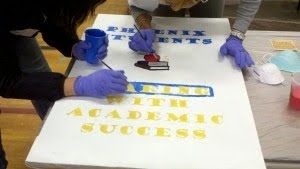
In the morning, we had a total of 30 volunteers, 12 in each locker room. The remaining six wrote letters to the troops, and painted murals we had previously sketched on canvas. The main goal for the morning shift of locker room volunteers was to move everything out of the locker rooms and into the cafeteria, where it would then be sorted. Our morning shift exceeded all of our expectations, and they were extremely hard working. Although each locker room had only 12 people, they were able to clear out both locker rooms with time left to spare. I was shocked! By the time the afternoon volunteers arrived, the locker rooms were totally cleared out, and more than half the stuff that was cluttering them was in the trash!
Despite the great morning success, our afternoon shift still had their work cut out for them. We had a total of 106 volunteers in the afternoon, 30 of which were in each locker room cleaning. Cleaning these locker rooms was a huge undertaking, and a responsibility that they accomplished without a single complaint. We had volunteers on their hands and knees scrubbing the floors, opening all the lockers and cleaning inside each one, as well as cleaning showers, toilets, and sinks. It was a huge job that, again, our volunteers completed with time to spare! The rest of our volunteers were stationed in the cafeteria, as well as in the gym, finishing the murals the morning volunteers started.
The people in the cafeteria also had their work cut out for them. They were in charge of sorting the piles of trash: going through and double checking to make sure that nothing in the trash pile should be moved over to the keep pile, as well as making numerous runs to the dumpster. They also were in charge of cleaning everything in the keep pile. Since all these items had been in a locker room for ten or more years, almost every item we kept needed a deep clean before it was usable. Once everything was cleaned, the volunteers were responsible for moving the items to different areas around the school.
The last job in the cafeteria was to go through the countless number of books that had been stored in the locker rooms and forgotten about. Anything that was old, ripped, or destroyed in any way was thrown out. Any usable books were moved to a classroom where staff will be able to go through them and decide what books to keep, and what books to donate. The cafeteria volunteers did a phenomenal job organizing everything, and then disposing everything to its proper place.

It was amazing to actually be able to walk through both the boys and girls locker rooms without bumping into something, and to feel like they were actually clean enough to use again. This project was very important to the Phoenix Corps members, the Phoenix staff, and me. Phoenix Academy is located in a very poor area in Detroit, where many families do not have running water. The plan for the newly cleaned and usable locker rooms is to allow students and their families who do not have running water to come into the school early, and use the showers in the locker rooms. The locker rooms are also equipped with working washers and dryers, where students will also be able to wash their clothes.
No student should have to come to school everyday without a warm shower and clean clothes, and hopefully these locker rooms will prevent that from happening. Therefore, it was a very special moment for the Phoenix principal and City Year Corps members to walk through the finished locker rooms, knowing what they will soon be used for.
 Hello everyone! My name is Corey Saylor. I am a second year AmeriCorps member serving with the Michigan Campaign to End Homelessness. I am currently serving my year at the South Oakland Shelter in Lathrup Village. My host agency has proven to be an AmeriCorps powerhouse. I am currently serving among two other individuals from the Michigan Campaign to End Homelessness as well as three VISTA members. I feel very fortunate to be surrounded by such great people all working towards the goal of ending homelessness.
 Serving at the South Oakland Shelter I encounter a wide array of individuals, all with their own stories and all facing homelessness. Each story has its own persona but some stories are too alike. One particular example is the story in which an individual is underemployed or has just been laid off from a company where they have worked for a decade or more. Another story that many parallel is one in which the individual or family had been making their rent payments to a landlord who did not own the home. Those tenants got evicted, lost their homes and ended up in the shelter.
 There is a disconnect somewhere, whether that is underemployment, unclear tenant rights or high housing costs, that is causing individuals and families to be at an ever increasing risk of homelessness. I do not have the solution to this disconnect, however, it is my hope that my service and the service of my fellow AmeriCorps members is leading us to that answer as we strive to end homelessness in Michigan.